Friday, February 23, 2007
Comic Opera
Anyway, I have reasonably fond memories of comic books, and I know a fair number of people at work who buy comic books with almost religious zeal, and now and then I try to catch the wave. But most modern comics don't appeal to me. I think what I miss is the idea of a comic book being about ordinary people. Sergeant Rock and his riflemen weren't mutants with super powers, or supernatural beings, or ninjas from shadowy organization that has developed techniques for mind control or anti-gravity. They were just ordinary guys, a squad of perfectly normal guys who had nothing but Garands, BARs, maybe a Bazooka, and their brains.
When I try to read X-men comics (of which there must be six or eight titles at least) all the mutants run together on me, and some of their mutations seem a little strange. Or a lot strange. Why is it that nobody has maladaptive mutations, like only being able to digest peanut butter, or having two left feet, or having one nostril large enough to house a teacup? The movie Men of Mystery parodied this - I especially loved The Shoveler, who, when his wife criticized his mutant power as being silly, just shrugged and said "It's what I do. I shovel." And then I get all wound around the figurative axle trying to make sense of some of them. Like Magneto. Can he only affect ferromagnetic metals, like iron? Or can he manipulate any metal, like aluminum? What about paramagnetic materials, like liquid oxygen? You see my problem. It gets even worse when I start to obsess about the various conservation laws. I once sat down to calculate how many Cheezit crackers Magneto would have to eat to generate enough energy to lift an airplane, but fortunately I came to my senses before I got very far along.
I found that I really liked the series The Red Star, with its odd mix of technology, magic, alternate history and brilliant artwork, but its creators seemed to stumble over their own egos and plans for a new line of The Red Star comics seem to have been scuttled.
I generally like The Punisher, which tends to be coarse and heavily R-rated, but at least harkens back to the moral clarity of Sergeant Rock (whatever else you want to believe about World War Two, it has to be admitted that there was a Good side and a Bad side, and it was imperative that Good triumph over Bad. Exactly how Good triumphed can and should be debated - was it necessary to nuke Hiroshima, for example - but whether Good should have triumphed is very much a closed question). But later runs of The Punisher seem to be falling into the same general trap that brutal death metal wandered into - the need to constantly one-up itself by constantly raising the brutality bar. It's not bad, really, since it is just a comic book, but I still get the feeling when I read certain panels that the writers sat around a table in a pizza shop saying "We need to kill this guy in a really cool way. Any ideas?" "Let's burn him to death!" "No, we did that in the last one." "Oh. Let's burn him to death with a plasma arc cutter!" "Yeah!" It's not the brutality that bothers me; it's the crass way brutality is exploited that bothers me. And you always know that no matter what happens, Frank Castle will get banged up, he'll grit his teeth, he'll emit some grim monologue, and then he'll mow down the Bad Guys. And then there's the backstory as shown in "Born" that suggests that the Punisher isn't really just a normal guy any more...
Frankly, I'd be just has happy with a new version of Sergeant Rock. No mutations, no god-like powers, no super-stealthy ninjas from obscure schools of martial arts, and no strange artifacts like the lasso that compels you tell the truth.
Thursday, February 22, 2007
Not Even Wrong
It is said that there is no single string theory as such. Instead, there is a "landscape" of a huge number of string theories - according to one estimate, 10E1500 (that's 10 followed by 1500 zeros) distinct string theories. When pressed on the point, string theorists insist that the theory is right, even if experiments and common sense argue otherwise, and what is really faulty isn't string theory, but our understanding of what a fundamental theory should do.
I think all of this is nonsense. Granted, I'm no string theorist, but it seems to me that string theory fails several common-sense real world tests. The first is that it seems to make no verifiable predictions at all. This is like me theorizing that there is an invisible demon in my garage. It isn't provable either way, so it's can't be a theory in the scientific sense. Another is that the theory depends on supersymmetry to work, and I'm sorry, but I find the whole notion of supersymmetry kind of far-fetched. One would think, one would, that if supersymmetrical partner particles existed, at least some of them would be light enough to be seen in existing particle colliders. (Why, given that the electron has a mass of, what, a few hundred KEV, would its supersymmetrical partner is much, much more massive?) But no - they're all just a little too massive to be produced by existing hardware, and when CERN's Large Hadron Collider comes on line, I suspect they'll still be a little too massive to be seen. Is it reasonable to assume that all the supersymmetry partners are above the 14 TEV or so energy LHC can generate, or is it reasonable to assume that in fact supersymmetry is an elegant mathematic formalism that has no connection with the real world? Another thing that bothers me is that string theory currently exists in five forms, and some of them predict the existence of tachyons, which seems to me to be prima facie evidence that that particular theory has a problem. (But I'm also dubious of the Higgs particle, which is predicted by quantum field theory and yet remains slightly too massive to be revealed by existing particle accelerators. So in a sense, nothing pleases me, since if I wave a magic wand and make the Higgs particle go away, nothing forces symmetry breakage in the Standard Model and the universe would have to look very different than it really does. But I'm not as dubious of the Higgs particle as I am of supersymmetrical partners - one particle being too massive to appear I can roll with ; a whole menagerie of them being too massive to appear starts to tickle my erroneous zone.)
String theory (more properly supersymmetrical string theory) could still turn out to be right. But it strikes me that the super-smart people behind string theory want me to take an awful lot on faith, including a series of conjectures that haven't been proved, as well as the entire notion of supersymmetry and the existence of Calabi-Yau manifolds that curl up the 'excess dimensions' that the theory requires to work. All of this could be true, but from where I sit, firmly in the world of engineering where theories and mathematics have strong predictive power, string theory seems a little suspect.
It's also possible I have a personal bias. I once knew a fellow who liked to joust with me on intellectual matters. I am an engineer by trade and tend to believe fundamental laws and mathematics, especially ones like Newton's Second Law of Motion. He was much more accomodating in his view of the universe and believed, among other things, that entropy can be reversed, that perpetual motion machines can be built, and that Nazi scientists had built a working anti-gravity drive. So when he told me he understood string theory, I automatically lumped string theory in with all the other junk he believed, junk that I will, for the sake of courtesy, merely call highly dubious.
I don't know what the real "theory of everything" is. I am forced to agree with Leonard Susskind to the extent that if there is a "theory of everything" we simply may not be smart enough to understand it, let alone formulate its basic mathematics. But I am also loath to abandon Einstein, who believed that we would know we had stumbled on the "theory of everything" because it would be beautiful and simple. String theory is neither beautiful nor simple, and so I remain dubious.
His Royal Majesty

My cat, the Emperor Maximus, in more or less his natural state. I am more of a cat person than a dog person, truth be told. Cats are generally (but not always) quieter, cleaner, easier to take care of, and less emotionally needy. Dogs sometimes seem to be co-dependent; they require constant reassurance that they aren't about to be put on the spit and barbecued, whereas cats really couldn't care less what we think of them. Dogs seem insecure; cats suffer from self-importance that almost borders on the kind of hubris Greek playwrights used to talk about.
Maximus is especially prone to lying on my chest when I'm trying to read in bed. I probably have lesions on my liver and pancreas shaped like cat footprints, and Max had puffed so much hair in my face it's a wonder that I don't hack up hairballs.
We have two other cats, but they lack Maximus's savoir-faire. Baxter sleeps in the closet all day and only comes out at night to leap between my stomach and the windowsill. Poopie wanders around all day looking haggard and annoyed and acting like she wants to barf on something expensive.
What was I saying about cats being easier to take care of than dogs? Give a dog a piece of bread and she's happy. Give a cat a slice of bread and they call the Mother Ship and arrange to have you turned into a cloud of ionized gas.
Sunday, February 18, 2007
Deputy Dawg
Oh heck, why not? Here's a picture of my dog, who I refer to with artful creativity as "Dawg" even though her name is Annie. She came from the pound and was scheduled to be put to sleep within a day or two when my wife saw her.
Dawg is trying very hard to look cute and mild in this photograph, but don't let that fool you. She goes through life emitting noise at an average of about 85 decibels. If it's not barking, then it's grunting or snorting or sneezing or stranger sounds yet. Still, the idea that she was within hours of being put to sleep just for being noisy appalls me.
But she means well, even if she sometimes does steal my cheesecake when I'm not looking.
And she's really not noisy. She's just having the best day ever, every day.
Chilling Irony
I feel the urge to put something new on my blog, but I can't think of anything serious to say. No, that's not quite right. I have plenty to say; I just don't have the energy to say it. So with that in mind, I present an old photograph of a model rocket accident that I find amusing.
Behold my shirt and my hands. In my hands is a gloss red Gemini DC model rocket. Note that the rocket has a hole blown through the side of the rocket, and that the rocket engine (and its retainer) have been blown halfway out the back of the rocket. In the Gemini DC, the two recovery parachutes are stowed in the "nacelles" on the sides of the main rocket and are driven out backwards by the ejection charge. In principle, anyway. In practice, the parachutes stuck in the tubes and the ejection charge blew out the side wall of the rocket.
Not too memorable, and not too amusing. But what gets me is that the blowout in my shirt is almost exactly the same size as the blowout in the rocket. That, to me, is chilling. (For the record, the blowout in my shirt was not caused by any kind of gas expulsion; I was grinding something with a Dremel tool and managed to grind a hole in my shirt.)
In the background is my Chevrolet truck, which I think has to go down in history as my favorite vehicle. It was stolen from the parking lot where I work, and when the surveillance video was reviewed, we discovered that it took them less than thirty seconds to make off with it. It still makes me so mad I could spit.
Saturday, February 17, 2007
What's funny is that you almost can't see the project I was working on for all the mess. It's a pair of Andreas 54mm Roman legionaries.
Friday, February 16, 2007
Wednesday, January 31, 2007
Chinese ASAT
The truth is that intercepting a satellite isn't especially difficult. If a country has the basic technology required to launch a satellite in the first place, it has all the technology it needs to intercept a satellite. Both the Soviet Union and the United States demonstrated that they could intercept satellites back in the 1980s, and both stopped doing so after a few tests because the tests tended to litter the heavens with tens of thousands of fragments of the sacrificial satellites.
In principle any spacefaring nation could intercept a satellite if it wanted to. The list of spacefaring nations includes the United States, Russia, Ukraine, the European Union, Japan, Israel, Brazil, India, and China. Even North Korea claims to have launched its own satellite, and Iran recently announced plans to launch its own satellite. Once you've got a booster that can put a payload in orbit, you've got about 90% of what you need to intercept a satellite.
Now, the Chinese test was of the so-called direct ascent type and not the simpler co-orbital type. A direct-ascent kill is harder to pull off than a co-orbital kill because you need a booster of higher performance and you need some sort of fairly precise terminal guidance system. But even so, it's not that hard. You could buy pretty much everything you need off the shelf, from booster to infrared sensor, and there are even websites where you can get the orbital elements of pretty much any satellite you're interested in so you can predict its position in the future.
So I view the successful Chinese test as a notable technical achievement, but nothing that is new or revolutionary or even all that threatening. It would have been much more threatening if we had not known about the test - if the Chinese had been able to kill the satellite without us knowing they had done it. Anyone with a big booster can kill a satellite in a messy and destructive way, but the true test of sophistication is being able to kill a satellite quietly, cleanly, and in such a way that it looks like the satellite just died on its own. And that would scare me - but of course, I wouldn't know, so it wouldn't scare me.
Saturday, January 13, 2007
Groggus Maximus
I logged on to AOL this morning to adjust our satellite TV account. We had grown weary of what we came to call the "Bruce Willis Channel" - that would be Starz, with its literally endless repeats of Armageddon, Mercury Rising and selections from the Die Hard family of movies. Does Bruce Willis own Starz? Or have I not been paying attention and somehow 85% of all movies ever made now star Bruce Willis? Not that I dislike Bruce Willis; I just don't want to watch Armageddon every night. Or any night. Once was enough.
But that's not the point. The point is that I logged on to AOL to adjust our satellite TV package to add HBO. I have a deep and apparently bottomless curiosity about Rome, and I confess the idea of watching the HBO series "Rome" appealed to me. And the idea of watching movies other than Armageddon also appealed to me. So we picked HBO, which combines new movies and "Rome", and thus are all plants watered.
And as usually happens, I got drawn into the pop cultural train wreck that is AOL's welcome screen. I regard the "lifestyle" and "entertainment" tabs on the AOL screen to be two somethings of the apocalypse. Maybe not two actual horsemen of the apocalypse, but maybe two stable boys of the apocalypse, or two mounting blocks of the apocalypse. The apocalypse aint here, but when you read the lifestyle and entertainment tabs, you can sort of see it coming.
So this morning I was nostril-deep in my coffee reading these press releases from the outer circles of trivial celebrity hell and saw something called "Natural Beauty", where AOL proposes to reveal its top ten picks for women who possess natural beauty and don't require "four hours in a makeup chair". Like a moth drawn to the headlights of a speeding Kenworth, I clicked on this story.
Ugh. My point isn't that the women listed in the article weren't beautiful. And I have no personal point of view on the great makeup-vs-no makeup argument. I don't dispute the fact that some women are naturally beautiful (and I might even go further and argue that most are naturally beautiful).
Here's what confused me. These ten women who are supposed to be exemplars of natural beauty who didn't need four hours of prep work to look good had all been subjected to four hours of prep work! Some of the photo captions even listed the makeup and hair artists who had done the work! So we can't even be sure that the women AOL listed really were naturally beautiful. We just have to take their word for it.
I think I need more coffee. A lot more coffee.
Wednesday, January 10, 2007
Insomnium
So let me rephrase. I recently happened to hear of a death metal band named Insomnium that I happen to like an awful lot. Better?
Thus far they've released three albums - "In The Halls Of Awaiting", "Since The Day It All Came Down", and "Above The Weeping World." The band does not get particularly high marks on www.bnr.com, which it describes as (and this is not a direct quote) good but not highly original. And maybe that's true, but there's something about this band's style that appeals to me very much.
Their first album, "In The Halls Of Awaiting", seems to me to be pretty deeply influenced by Swedish melodic death metal of the Gothenburg type. The album brings to mind Dark Tranquility or In Flames, depending on the song, but even then, the approach isn't straight imitation. For one thing, Insomnium's lyrics make sense to me, after a fashion. I enjoy Dark Tranquility a great deal, but when I look up their lyrics on www.darklyrics.com, the words still make no sense to me. Insomnium's lyrics are considerably more poetic, though since they are probably translated from Finnish there are places where the lyric flow gets a little lost. Plus one hears here and there on the album doom metal influences - it is in places much slower and more somber than conventional death metal, and there is thankfully next to none of that Florida school drum-pounding business.
Their second album, "The Day It All Came Down", is even better. The Gothenburg death metal influence is still there, but the doom metal influence is much stronger. The pace is slower, the mood is more somber, and the lyrics continue to be epic and poetic. "The Daughter Of The Moon" is particularly good, half death metal and half doom metal and all good. The parts with the slow whispered lyrics send chills down my spine. Some of the songs show more Gothenburg influence and others show more doom influence, but taken as a whole, the album is an excellent listen, somber and atmospheric without being sappy.
I haven't heard their third album all the way through yet, so I have to withhold comment, but what I've heard so far sounds pretty good, the same nice mix of melodic death and doom, stylistically similar to the second album, and just as polished.
There are certain tropes in death metal that fatigue me. One is the "brutality arms race" where the quality of the music is apparently proportional to the brutality of the lyrics. Though is is mostly a feature of American death metal, the Scandinavians aren't above this sort of thing either. (And let's face it, Scandinavia is the real home of death metal). I shall cite as my example Dismember, which isn't bad musically. It sounds like grindcore filtered through Carcass, with the same characteristic guitar sound that is sometimes called the "electric saw". But the lyrics! If songs like "Skin Her Alive" or "Sickening Art" don't unsettle you, you just aren't paying attention. They're brutal for the sake of being brutal, though cynics could argue that since the vocals are indecipherable anyway, they might as well be using a grocery list for lyrics. There are worse examples, but the point is that some bands seem to be brutal and disgusting just for the sake of being brutal and disgusting, an arms race of tastelessness that after a while I grow weary of (though I should point out there are bands that as a matter of deliberate practice parody this tendency by being outrageously, heroically tacky).
The other main trope is Satanism, often ridiculously over-the-top Satanism that is clearly intended to sell albums to self-hating teenagers who think Satanism will provide answers to questions like "How come nobody likes me?" This is such a defining trait of black metal that you almost can't have black metal that doesn't mention Satanism in some way, but it also exists in some forms of death metal, most notably the stuff that comes out of Florida (and yes, I'm thinking of Deicide).* I grow weary of this sort of nonsense pretty quickly, and no, it isn't because the Satanic point of view shakes my beliefs - it takes more than tattooing an upside-down crucifix on your forehead to "challenge my beliefs". I'm just readily fatigued by the way they use Satanism as a crass marketing tool. This is why I don't listen to Deicide or black metal acts like Dimmu Borgir, because the shameless exploitation of their ingrained Satanism just wears me down.
It is against this background that I find Insomnium especially pleasing. It's extreme metal, make no mistake, but extreme metal of unusual musical sophistication and highly unusual lyrical taste. Instead of extolling the dubious virtues of brutality, violence and schlock blasphemy, Insomnium is much more subtle. The prevailing mood is somber rather than violent, with most of the songs being about loss, longing and regret rather than hacking people apart with medical instruments or sacrificing black chickens to Satan. The mix of death metal and doom metal is very sophisticated and atmospheric, and I frankly can't get enough of it. It isn't uplifting music that makes one want to dance and sing the way Bowling For Soup does. (Yes, my droogies, I like Bowling For Soup a lot too.) But as a slice of atmospheric, somber, and very advanced and sophisticated doom/death metal, Insomnium seems pretty hard to beat.
(I have to be careful with terms like "doomdeath metal" because there is already a class of music known as doomdeath, which includes bands like My Dying Bride. Insomnium isn't as doomy as doomdeath metal, but it isn't as deathy as death metal. So what is it? It's good, that's what it is!)
*There is a genre of black metal, usually from Norwegian bands, that is anti-Christian but not Satanic. This genre is sometimes called "Viking metal" because it isn't clear that it can be black metal without being Satanic.
Saturday, January 06, 2007
Torpedo Boat Flotilla

Here's a bad picture of my fleet of 1/72nd scale torpedo boats. Why not?
The long grey one in the foreground is a German S-100. Behind it is a Lindberg "Coast Guard patrol boat", whatever that means. Aft of the S-100 is a Revell PT-109, and behind the PT-109 is an Airfix Vosper MBT.
The PT-109 is an old Revell kit. It's been around for a long time, and the molds seem to be deteriorating. The crew figures are misshapen and mutant, and thin parts like the propeller shafts and 20mm gun barrel are almost unusable. Flash and mold misalignment plague most of the other small parts. I replaced the shafts with wire, but managed to make the screws, depression railings, .5o-caliber guns and other small parts work. I added a 37mm deck gun from White Ensign Models, which curiously enough was harder to assemble than the PT-109 in the first place. I don't know what White Ensign uses for its "white metal parts", but they seem particularly immune to super glue. Most of the itme I spent on the model was spent improving the torpedo tubes - removing the seams and scratchbuilding representations of the loading hatches. When I do this kit again (as surely I will) I intend to model a boat from later in the war, with a 40mm Bofors, 37mm automatic cannon, lightweight torpedoes and torpedo racks, and masthead radar.
The Airfix MBT is a surprisingly nice kit, a bit unconvential in terms of engineering but it builts up into a pleasingly cluttered and detail-rich model. The crew figures are good, though the twin 20mm guns are not great. Beats me how the magazines attach to the guns! I faked it, and it looks okay from a distance, but my solution is not correct.
The Lindberg patrol boat is also surprisingly nice. It came with hardware so it could be battery-powered, but I left that out. The main problem with the kit is that I can't find any references for it. I have no idea what kind of boat it is. The 20mm guns are also dreadful; I replaced them with a single 20mm Oerlikon from an old PT-109 kit.
The Revell S-100 is the most modern of the four, and is a very nice kit, well-detailed, well-engineered and nice-fitting with a couple of exceptions. One is that the screws take a lot of work to make them look decent, and even then they don't match the real screws. Another is that the 37mm gun is dreadful. And the last is that the kit comes with no crew figures. I bought a set of Revell vinyl Kriegsmarine crew figures and I'll eventually paint a few for the S-100 (and for the Type-VIIC U-boat that I haven't started yet) but for now, the kit is devoid of crew. And what's up with that misshapen jaguar on the decal sheet?
Pay no attention to the collection of 1/70oth scale battleships!
The Second Tractor

This is my second tractor, a 1956 Ford 850. It is closely related to but slightly larger than the more common 8N and 9N tractors, but it has a five-speed transmission with a "Christmas Tree" shifter instead of the four-speed found in N-series tractors. It has been nicely restored, with the only major problems from a restoration point of view being a non-stock seat, no decals, and no headlights. It was my Christmas present. Shortly before Christmas we saw it on the side of the road for sale, and we stopped and bought it. We probably paid a little bit too much for it, but the price we paid wasn't outrageous by any means.
Why a 1956 Ford 850? Nostalgia, mainly. I like vintage equipment, and it reminded me of the 9N that my grandfather had, and I think it was a certain visual appeal compared to the hyper-modern hydrostatic fully-loaded "compact tractors" some of my neighbors have. And I could hitch my $4,000 Ford 850 to my neighbor's $20,000 New Holland "compact" and tow the New Holland backwards for as long as I wanted to. One of the problems one faces when buying vintage tractors is the dread spectre of the "proprietary hitch". But with a Ford, this isn't a problem. The Ferguson-Ford hitch arrangement became the standard type, so any modern category-one three point implement should hitch right up, unlike the case with other vintage tractors, where a certain amount of adaptation is sometimes necessary. I'm not sure if the Ford's PTO output is standard, but since I don't have any PTO attachments, it's irrelevant for now. (And, frankly, a lot of PTO attachments kind of scare me anyway.)
It came with the blade as shown above, but it was rusted to the point it wouldn't pivot. Some persuasion with Liquid Wrench, a long 4x4 and my largest hammer broke it loose, though, and now I can pivot the blade just by leaning on it. I want to find a one-bottom plow or hardpan breaker for it now - the tractor is shown sitting on the spot that will one day be our garden, but I currently have no implements that will break up the hard desert soil.
It starts easily and runs well. It is quiet. It is also fast in fifth gear. The only leak is a tiny bit of seepage from the front main seal. The hydraulics, transmission and differential are tight and leak-free. The clutch doesn't grab or chatter. When I first got it, the right brake hardly worked at all, but fixing it was a simple matter of adjustment. When I first got it, it steered fairly hard to the left, but after pumping a bunch of grease into the front end it works much better. There are a couple of cracks where the top link attaches to the draft control linkage, but I can weld those. And the hood is difficult to latch because I think it's slightly misaligned.
I'm very pleased with it. It isn't as handy as my lawn tractor, but it'll do work that my lawn tractor won't. I've moved quite a bit of dirt with it already, mostly building a flood control berm along the north and west sides of our property, and I've used it to fix our private haul road and to build a private horse cart path around the back of our property. And sometimes, I confess, I start it up and fiddle with it just because it's fun. My two tractors work pretty well together. The Ford breaks up, moves and positions the dirt; and the Bolens does the final grading.
I've ordered some stuff for it. I ordered three generic 12-volt headlights (the tractor is already a 12-volt system with an alternator) so I can mount two on the front and one at the rear as a work light. My wife ordered me the user's manual, shop manual and parts manual (that's how I knew how to adjust the brakes!).
Now I just need a plow. And a box scraper. And forklift blades. And a post-hole digger. And a PTO tiller. And a three-point hitch disk. And... And...
The First Tractor


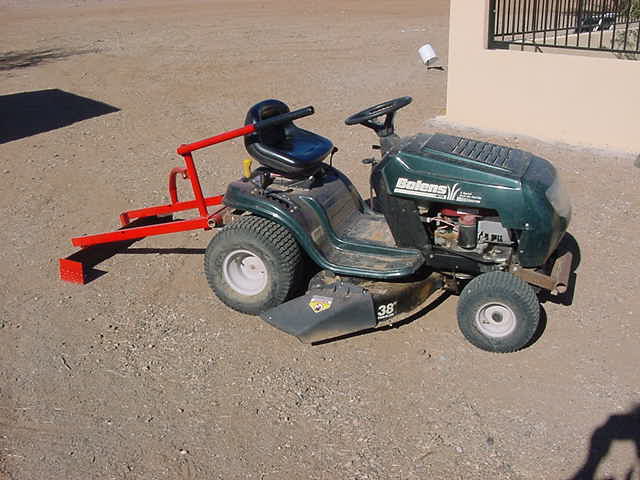
This is my first tractor. Yeah, I know, it's a lawn tractor, and worse yet, an $800 chain store tractor. Not even a good lawn tractor, you sniff dismissively. But I have to say, this tractor has given us superb service. All I've ever had to do to it is change the oil, clean the air filter, put gas in it, and fix flat tires.
It's just your basic 15.5-horsepower Bolens, and I originally bought it because my property was seriously overgrown with dead grass and weeds that posed a serious grassfire risk. So I bought this thing and proceeded to mow brush for about a week. It would have been faster to use a real tractor and a brush mower, but not being able to afford a real tractor and a brush mower, I used this. And I used it hard too, mowing brush and weeds three or four feet tall on rolling and uneven ground, and other than getting stuck a time or two, the tractor never quit. I had to fix five or six flat tires (mesquite thorns go right through the thin "Turf-Saver" tires) but then I put a tube of green Slime in each tire and the problem with flats went away.
Then I bought one of those cheap $60 stamped-metal assemble-it-yourself wagons for it, and I've used it as a motorized wheelbarrow for about two years. And I've used it a lot. I've moved tons and tons of dirt and gravel, scrap iron, manure, furniture, rocks and brush with it. The original paper-thin tires lasted about six months, then they sprang hundreds of spontaneous leaks. I covered the tires with soapy water to find out where they were leaking, and there were so many leaks the tires looked like they were foaming. So I ordered a set of beefy, muscular hand truck tires from Northern Tool and managed, through the proper employment of words I wouldn't want my kids to say, to get them forced onto the rims and got them to inflate. Since then, the cart had put in many a hard day of work with no complaints at all.
I realized I could drop the mower deck to its lowest position and use it as a grader. My neighbors think I'm mowing dirt, but I'm actually grading with the blades disengaged. It works really surprisingly well, so long as the dirt is soft, but a few passes with the deck and the dirt is smooth and level and nicely graded.
My son left a bunch of scrap iron with me after he quit working for a metal fabrication shop, and I built the blade shown in the picture out of those scraps. That was about a year ago, and time and use revealed certain weaknesses in my design and my welding technique. I fixed the weak welds, added a few gussets where necessary, and changed the design of the hand-powered lifting lever. Then I covered it with red spray paint so it wouldn't look quite so much like Depression-era junk. It may look cheesy, and it certainly won't dig in hard ground, but it's excellent for cleaning stalls, spreading soft dirt and gravel, and skimming big rocks off the ground. The tractor pulls it without any problem, and will pull it even when the blade is overflowing. And it doesn't interfere with the normal trailer hitch, so I don't have to unbolt anything to switch from the blade to the trailer - I just pull out a piece of pipe that serves as the blade's hinge pin, and it drops right off. I can dismount the blade without even getting off the tractor.
It is also handy, because it will fit through standard equestrian gates and will turn in a relatively short radius, making it highly useful in stalls and tight areas.
Also visible in one of the pictures is a mount I made for a dozer blade, which I also made. The dozer blade proved to be relatively unsuccessful. The geometry of the mount is such that it tends to lift the front wheels of the tractor off the ground, plus when pushing things the nose of the tractor makes ominous creaking noises. So I discontinued use of the dozer blade, but the rear box scraper remains in frequent use.
My point, and I guess I have one, is that I am very pleased with my chain store lawn tractor. It is about three years old now and it has proved to be very reliable, other than a burned-out headlight, and it starts every time. My future plans for the tractor are mostly related to tires. I want to order tougher, burlier tires for it from Northern Tool, and since I'm not worried about saving my turf, I'm going to see if I can find rear tires with lugs. It doesn't need the additional traction; I just think it would look boss. And I have vague notions of building a genuine midships grader blade, with adjustable sweep angle, that uses the stock mower deck mounting points and height adjustment mechanism. Why? Because it would be boss!
If I have any complaint with the tractor at all, it is this. I lost the plastic trough you're supposed to use when you drain the oil, and without it, the tractor kind of makes a mess of itself when you remove the oil drain plug. I think I can live with that.
Sunday, December 17, 2006
If I Were King...
Maybe the first thing I would do if I was King was put news back on Headline News and send Glenn Beck and Nancy Grace back to whence they came. A disgrunted partisan hack and Roland Friesler in nice clothes - I certainly never asked for either one.
But I digress. If I were King, I'd bring Pro Mod and AA/FA back to the NHRA. I was never sure what the movitation for killing Pro Mod was, but in retrospect it seems obvious it was a mistake. Cars with huge V-8s and blowers sticking out of their hoods? What's not to like? This isn't to take anything away from Pro Stock, which is certainly cool in its own right, but c'mon, we're talking about big blowers here!
I read in a book a while back that the NHRA scuttled the AA/FA ("Fuel Altered") class because of the popularly of Funny Cars and the fact that AA/FA cars were more or less indistinguishable from Funny Cars anyway. True? I don't know. I've only seen two FA cars run in person in my life, and most of what I know about the class comes from old magazines and books, so I may not have the slightest idea of what I'm talking about. But I do know that at my local drag strip, as soon as a FA car fires up, everyone stands up and all the guys that were in line to get Cokes at the snack bar or get rid of Cokes at the bathroom turn around to watch the run. Now, this is against a backdrop of cars that, while impressive and fast on their own, are not powered by nitromethane. If there were a bunch of top fuelers or funny cars there, would anyone give a hoot about a Fuel Altered with a ridiculous Topolino body?
Of course they would! They would because I, as King, would decree that it be so.
(Tellingly enough, I've seen about nine FA runs, and only one of them was clean. The others were marred by blown engines, wall rubs and other hijinks brought on by piling too much horsepower on too little car. But that one clean run, somewhere in the vicinity of 5.4 seconds if I remember correctly, that was magic. And there was no prying the grin off the driver's face.)
And while I'm at it, I would decree that the NHRA continue to get crappy TV coverage. One of my greatest fears (in drag racing anyway) is that the NHRA will suddenly become hugely and peculiarly popular for no apparent reason in the way the NASCAR suddenly became hugely and peculiarily popular. I think that would be bad.
Pinks is bad enough. People turn on this wretched program and think they're going to be watching drag racing, but it is to drag racing as the WWE is to Greco-Roman wrestling. It's all a bunch of ego-fueled posing and bad-mouthing, exactly the kind of Dueling Testicles crap I don't want to watch on TV. They could settle the matter at hand within the first 15 seconds of the show. Start your damn cars, get in, and race. But no. The principals must bop heads in a metaphorical sense, shout hoarse nonsense, threaten to take their basketballs and go home, and suddenly remember they were scheduled for tap dance lessons and can't race after all.
And when they do race, some guy waves them off the line with his hat. What is this, a time warp? Is it 1951 again? You mean to say we installed all those fancy timing systems at our drag strips so we can ignore them and wave cars off with our hats?
Oh, right. It's not about racing. It's about drama.
My mistake.
Friday, December 15, 2006
VALIS
My favorite part of the book by far, aside from the idea of Soviet technicians scurrying around in the background behind the three-eyed alien cyborgs in Horselover Fat's bizarre vision, is when the narrator talks about his persistent dreams of living in a nice house by a lake in northern California, a house he doesn't own near a lake that doesn't exist with a wife he never had. (For the record, yes, I know that Horselover Fat and the narrator are one and the same, but one of the glories of the book is the way he effortlessly convinces you that they are separate people even though he goes out of his way to remind you that they are not separate people.)
He concludes that not only is the landscape and population in his dreams wrong, but the ideology is wrong. He doesn't even want to live that way, would rather eat a dead dog than succumb to that kind of suburban swill - but the dreams are nevertheless extremely pleasant. He concludes in the end that he isn't dreaming his dreams but is in fact dreaming his father's dreams.
Maybe. Maybe not.
What interests me about this is that I also have recurrent dreams that always take place in a constrained geographical region that doesn't exist, in my case, an entirely fictional part of central Arizona somewhere between Camp Verde and Phoenix. This landscape is fairly rugged, ridged with mountains and slashed with valleys, and the roads wind painfully up and down the mountains in endless switchbacks. But what's really interesting is that this landscale is dominated by what can only be called Herculean earthmoving projects - highways, dams, tunnels and weirder things yet - sometimes I encounter titanic earthmoving projects that appear to have no purpose other than their own mere existence, as though someone decided to move 300 million cubic yards of earth just for the sheer hell of it.
Unlike the narrator's dreams, I don't find this landscape or ideology unnerving. Well, sometimes I do - sometimes the earthmoving projects are a bit hair-raising with dozers and tandem scrapers perched on the narrowest cuts on the sides of nearly vertical slopes, bringing to mind the Fun Old Days when doing my job involved running the right track of my D6C halfway out over the abyss... Strange, isn't it, that I never see hydraulic excavators in my mythic landscape. It's always oval-track dozers, D9Gs to be specific, and strange tractor scrapers like Cat 630s or DW-20s, or Euclid TSS-24s, or even older "pans" pulled by bladeless D9s, and spidery draglines and - oh dear - Wabco graders.
I once dreamed that I was riding on the back of such a grader, gripping the exhaust stack while someone else drove. It was raining and the grader's tires were throwing up great sprays of muddy water, and I decided I didn't want to ride on the back of the grader any more. I tapped on the glass and the driver turned and I saw that it was Adolf Hitler wearing a stamped-metal hard hat. Huh. Go figure that one out. Maybe we would all have been better off if Hitler had been a crabby, dyspeptic grader operator instead of a monstrous dictator...
When I was a kid there were only two kinds of landscape: that which was flat enough to be built on as it was, and that which required a bigger dozer before it could be built upon. I think that's the message of my dream landscape, that no matter what the terrain is like, we (mankind in general) can master it with the proper application of engineering, willpower, guts, and heavy equipment.
Which doesn't have much to do with VALIS at all, now that I think about it, except for the shared habit of dreaming about a specific geographic locale that doesn't actually exist. Well, that and my habit of sitting out on the patio at night and speculating about Gnosticism.
Thursday, December 07, 2006
And They Laugh At MY Music
A day or so ago I watched a news story about the Billboard music awards. I'm not a big fan of music awards - I think they are fundamentally irrelevant. I know the kinds of music I like and I don't need to buttress my tottering ego by listening to what's new or cool. And, let's be honest, the music that is likely to win awards just isn't made for me. You like pop music? By all means, enjoy it in good health.
But please stop barging into my cubicle at work just so you can sneer at the music I listen to.
Monday, November 06, 2006
"Lost"
I was expecting... Oh, I didn't know what to expect. A modern version of Robinson Crusoe, a dramatized version of Survivor, perhaps a slightly grubbier version of Dallas.
But no, it's actually very different, even weird. And therefore good. It's just weird enough to engage that part of me that enjoys science fiction, but not so weird that it repulses that part of me that prefers more mainstream fare.
Nicely done - so far.
Monday, October 30, 2006
Revell S-100 Schnellboot
But I have to ask something. Why, given the high quality of the kit in general, is the 37mm gun such a wreck? Everything else is so good; why is the 37mm gun so simplified and blocky, and why its its barrel and muzzle so unlike the real gun? Not a big deal, but it's kind of annoying. Maybe someday I'll build (or find) a replacement barrel for it. I have an Airfix 40mm Bofors in my collection; I suppose I could donate it to that cause since some S-100s carried the 40mm Bofors, but I have pre-existing plans for that gun, namely, arming a late-war US PT boat at such time as I find another model of said boat. I'd try to cast it in resin, but I historically have problems casting long thin pieces like gun barrels. 120mm figures? Sure. Small-scale guns? Tricky.
I also didn't pay enough attention to the instructions. I like to study the instructions before I start building, mainly so I can plan construction around painting, but this time I was apparently watching TV while I studied them and completely missed the requirement to drill holes in the hull for the Effekt rudders and outboard propeller shaft housings. I had to measure and eyeball and drill the holes from the outside, and I think I placed the propeller shaft housing holes just a tad too far aft, and the Effekt rudder holes just a tad too far outboard. It's not really noticeable since all this is under the hull, but just knowing it's there kind of irritates me.
I also failed to cut off the mounting rings for the two inboard smoke generators, so when I went to put the depth charge rails on, they didn't lie completely flat. Doh! Again it's not terribly noticeable, but when I get around to scratchbuilding some depth charges, the problem may get worse. I suppose I could always cut them off, sand the area flat and respray it, but it would have been easier if I had been paying attention in the first place.
So who's up for some schnellboot weiss? Not me! My local hobby shop carries schnellboot weiss, but only in acrylic form, and I personally don't have much success airbrushing acrylics. I prefer my paints toxic and smelly, apparently, so I found an extremely light gray in the Model Master II rack and used it.
Even though I put the boat on the shelf, I'm not sure I'm done with it. I still want to do something about that terrible 37mm gun barrel, I want to scratchbuild some depth charges, I need to paint up some 1/72nd scale crewmen, and I think the boat needs a little weathering. Given my current rate of progress, I'll get to it in, oh, about four centuries.
Waking Up
Or not.
Grousing about it would also be a violation of my NDA.
So I'll have to be content with expressing my utter disgust for durian. If it isn't the worst thing I've ever smelled, it's got to be a close second. And people eat it! I'm appalled!
And that's no violation of any NDA, though I suppose now the Durian Grower's Association is going to send some thugs around to break my tumbs.
Monday, October 16, 2006
Short Rounds
1. The other day I was driving to work and saw a National Guard 5-ton truck towing a 155mm M198 howitzer. The Guardsmen were probably going to the local dragstrip, where the National Guard displays (among other things) towed field artillery as recruiting tools. It made me smile, watching this truly immense truck with equally immense howitzer wading through the massed ranks of SUVs and raised pickups. I wonder how many egos it bruised. I see that an M198 costs about $550,000 at the bulk government rate. I'd probably have to come up with about $750,000 to buy one. I imagine a modern field piece parked in the front yard would make the county just a tad nervous, not to mention the neighbors.
2. I just watched Monday Night Football and witnessed another remarkable collapse by the Arizona Cardinals. I live in Arizona, and even I thought it was funny how fast the wheels fell off the cart. Mind you, I don't watch a lot of football. Or even much football. I hardly ever watch football, actually, and my immune system seems to be very efficient at wiping out the football fever virus. There's too much relentless self-promotion in football these days for my taste.
3. I see that the name of the new stadium for the Arizona Cardinals, built and paid for by the taxpayers of Glendale, Arizona, is now named the "Univeristy of Phoenix Stadium." The hell??? It should have been named the "Sales Tax Increase Stadium" or the "Thank You Taxpayers Stadium". I'm glad I don't live in a part of Arizona that was taxed to build said stadium - knowing that I paid for that stadium where the Cardinals humiliate themselves would make me yearn for strong drink. Another good reason to live in an unincorporated area - I'm not taxed so a rich sports team owner can get even richer. I'll gladly refuse the illusory improvement in my "quality of life" in return for not having to help pay for the stadium.
4. I watched "V for Vendetta" the other day, and it was better than I expected. I had to watch it for some twenty minutes before the ridiculous Guy Fawkes mask stopped making me laugh, but once I got over that, it wasn't bad.
5. I recently built a 1/72nd scale Emhar Mark-IV tank, the old Great War rhomboid dinosaur. Very nice kit, I have to say, with nice detail and even better decals. The unditching rails were fiddlesome and I came close to scuppering them a couple of times, but on the whole, I was quite pleased. I'm starting to develop a taste for 1/72nd scale armor (as opposed to the more mainstream 1/35th scale).
6. Wheldon complains that the investigation of his doings is "politically motivated." Once again, I have to say, the hell??? Last time I checked, the director of the FBI was Robert S. Mueller III, appointed by President Bush. Yeah, there's your liberal conspiracy for you - a conservative appointed by a conservative investigating a conservative. He'd have as much luck trying to convince me it is a UFO conspiracy what is bringing him down.
7. But maybe it is UFOs. I recently read that "a majority" of Americans are convinced of the "reality of UFOs". They didn't quantify "majority" nor did they define the "reality of UFOs" but nevertheless, I don't know whether to laugh or cry. Mostly laugh. I'd be surprised if it turned out we were the only sentient species in the universe, but I'd be even more surprised if other sentient species were visiting us. My sense is that if we were being visited, we'd know for sure and wouldn't have to rely on wide-eyed and entirely uncritical "documentaries" on the Sci-Fi Channel, or the testimony of people whose UFO contact stories always seem to involve largish quantities of Jim Beam.
8. My friend's wife is having her baby this week - or should I say, they're both hoping she has the baby this week. I wish them the best of luck, but I also dread that moment when they tell me the new arrival's name. I confess that I prefer solid, established names that don't kowtow to fashion or some yuppie's demented urge to be unique. I find trendy yuppie made-up baby names silly, but when they mangle the spelling of existing names to make them "yuneek" I have to choke down a horse tranquilizer to avoid screeching at them like the Pod People in Invasion of the Body-Snatchers. So here's hoping A) that baby and mother come out of this experience healthy, and B) when they tell me the baby's name, it ISN'T something like "Madycen" or "Gessikah" or - Heaven help us - "Nevaeh". Yes, I know it's Heaven spelled backwards, and no, I don't think it's kyoot or yuneek or spayshul at all. Mostly, it's cylly.
9. I'm kind of a language snob and most neologisms rub the wrong way (unless, of course, I coined the neologism in the first place. I'm a language snob, and a hypocrite too). So a few days ago I was walking through my workplace en route to nowhere special and saw a big poster on the wall that spelled out our mission statement. I'm used to the term "mission statement" these days and it hardly fires any neurons at all in that part of my brain that handles tragic irony. But appended to the mission statement was something new - a "Burning Platform." Gagging, I returned to my desk and Googled "burning platform" and read this:
When the oil platform Piper Alpha in the North Sea caught fire, a worker was trapped by the fire on the edge of the platform. Rather than [face] certain death in the fire, he chose probable death by jumping 100 feet into the freezing sea. The term 'burning platform' is now used to describe a situation where people are forced to act by dint of the alternative being somewhat worse. The crisis may already exist and just needs to be highlighted.
So all of a sudden the desperate, agonizing decision to jump out of a burning rig and face quick death on impact with the ocean instead of lingering death on a burning rig has turned into an atrocious piece of management-consultant lingo. What's worse is that there was already a perfectly good word to describe this situation.
Dilemma - A forced choice between courses of action (usually two) which are equally unacceptable.
But I guess "dilemma" just isn't hip in that glib, corporate way so cherished by suits and consultants. If I were that poor guy on the Piper Alpha rig, I'd haunt every last corporate insultant who used the phrase "burning platform" to describe anything other than a platform that happens to be on fire.
Friday, October 13, 2006
Cuba, yes?
There is Cuba itself, said to be the last country to officially espouse old-school Leninism. I don’t know if that claim is true, but certainly Cuba is one of the last unabashedly Communist regimes, a political stance that seems kind of silly to me. It’s like being the last feudal kingdom, or the last doctor to treat diseases with bloodletting – someone has to be last, but it’s nothing to be proud of.
I don’t get the way Cuba seems to dominate American politics either. The world is full of interesting challenges – nuclear tensions in south Asia, the rise of Jihadism, how to police Afghanistan, how to salvage something from the mess of Iraq, the negotiation of multilateral trade deals that could affect millions of people. But instead of paying attention to that, we’re transfixed by the image of an old man with a scruffy beard and a green military hat.
I’ve never understood our policy toward Cuba, or rather our lack of policy toward Cuba, and I surely don’t understand why events in Cuba are given considerably more coverage than events in Russia.
Russia: Huge geographic size, large population, immense petroleum reserves, powerful nuclear arsenal, large if somewhat demoralized army, competent nuclear and chemical scientists, and a substantial and deepening role in the industrialized economy.
Cuba: Geographically tiny, small population, no oil reserves I’ve ever heard of, no ability to attack targets off of Cuba itself, and essentially no world role at all except as a nebulous example to other vaguely leftist Latin American governments.
Based on news coverage, one could be excused for imagining that Cuba was Russia and vice versa. We analyze every random rumbling from Castro’s bowels with the seriousness of a Dan Brown fan trying to interpret a late medieval tapestry, while momentous things happen in Russia and we shrug and say “Eh, it’s some kind of Slavic deal, we don’t know.”
The easiest way to defeat a Communist regime is to let its own people subvert it from within. It happened in Russia, it happened throughout Eastern Europe, and it’s happening in China and Vietnam. Allow the citizens of the communist regime to perceive the vast gulf between what was promised and what was delivered, allow them to appreciate the western economic model, allow them to appreciate western ideas in participative government, and pretty soon the whole Lenin-encrusted edifice collapses. And it usually collapses peacefully, the old-line Communist regime simply being rendered irrelevant by economic and cultural facts on the ground.
Why don’t we do this with Cuba? Why do we treat Cuba with the seriousness of a rogue nuclear state? Why do we issue veiled threats of military action? All this does is unite the Cuban people behind their leadership and give them the feeling they are rallying in the face of an external enemy. All of this over a country that has no missiles, no effective air force, no ability to carry out attacks on US territory, and no superpower benefactor.
I just don’t get it. I’m told that we can’t engage with Cuba without somehow legitimizing Castro. But we engaged with the Soviets without legitimizing them. We engaged with Vietnam without legitimizing them. We engaged with China without legitimizing them either. What’s different with Cuba?
I honestly don’t know what’s different. I think in some cases old Cold Warriors are reluctant to part with the Cuba-as-an-enemy stance because it’s the last morsel of the Cold War left for them to savor. I can actually almost understand that position. Whatever else the Cold War was, it offered a certain bracing moral simplicity. One was either a capitalist pig or a Commie stooge; there was no real middle ground. The conflict was uncommonly clearly defined, and almost any kind of political or economic activity could have Cold War overtones (even high school chess tournaments got wrapped up in the Cold War eschatology, imbuing them with a kind of faux drama that apparently appeals to high school chess players and Cold Warriors).
The post-USSR world is scary and ambiguous. In the old days we knew who the enemy was, and we knew it could be held at bay by a combination of horrific nuclear deterrence and ideological rigor. Or so we were told, and in truth there were effectively no major confrontations between the West and the USSR. Proxy wars, sure, but in the end American and Soviet missile-men never came to blows.
The modern world is much scarier. Our fleets of bombers don’t deter terrorists. Our ballistic missile submarines, each loaded with enough nukes to transform a continent into a wasteland, don’t stop masked men from heaving RPG-7s at us. Our comforting Cold War eschatology suddenly shudders to a halt and bursts into flames when confronted with religious and ethnic struggles that we don’t understand and can't win in any meaningful military sense. Being a superpower doesn’t mean squat these days.
Maybe that’s why we vapor over Cuba. It reminds us of simpler times. It’s like a photo album of those heady days when B-52s and Minuteman IIs delivered as much security as they promised.
Human Beans
There were about twelve of us working at the farm. Ten of us were young male Mexicans. In today’s language they would be called “undocumented workers”. Back in the 1970s, they were called something else. They generally referred to one another as “mojies”, which I believe to be a contraction of mojados, or “those who are wet”. Today we avoid the use of terms like “wetback” and “mojie” because they express a kind of neo-colonialism, but back then, they weren’t so much terms of opprobrium as socio-economic labels. The eleventh guy at the pig farm was a much older gentleman, also a mojie, who did the cooking. The twelfth guy was me, a pudgy white suburban kid. My job was to provide unintentional comic relief.
The defining characteristic of a pig farm is the presence of large numbers of pigs. Pigs are gruesome creatures, as far as I’m concerned. Back in the 1970s the west side of Phoenix was dotted with feed lots and on warm summer nights the smell of concentrated cattle manure could rise to nearly life-threatening concentrations, but cow manure is ambrosia compared to the vile sticky mess that is pig shit. (It doesn’t deserve the discreet nomenclature “manure”. It is not manure. It is shit, pure and simple.) Black, vile, odiferous, heaped up in banks, wallowed into mud holes, it was literally everywhere.
But pig shit was a picnic compared to what we fed the pigs. Jose had worked out an arrangement with the Shamrock Dairy where he bought any of their products that could not be sold in grocery stores. And this was the 1970s, before people developed the hair trigger reflex to check the sell-by date on their dairy products. Every so often (my memory says “weekly”) a crew would drive from the pig farm to the Shamrock Dairy, which was more or less in downtown Phoenix, and we would load the tractor-trailer rig with whatever Shamrock didn’t want. Milk, cream, orange juice, essentially anything the dairy couldn’t sell went into the truck. Even potato chips and bread, though exactly how they ended up at the dairy remains a mystery to me.
So we’d drive this mess back to the pig farm, trailing a cloud of rotten milk gas. I remember riding in the trailer, sitting atop leaning heaps of dead and dying milk, heaving half-pints of milk at road signs. It’s a wonder nobody was ever killed riding on that trailer, or that we weren’t struck by lightning by a vengeful God for our sheer gall.
Back at the pig farm, one would now face the job of dumping the rotten dairy products into the tank. The tank was a large cylindrical water tank with no top. One stood on a rickety wooden platform next to the tank, grabbed cartons of milk off the truck, and dumped them into the open top of the tank. The stench that rose from the tank defies description – the mere memory of it makes my eyes water to this day. The stuff in the tank looked a bit like soupy sour cream, but it usually couldn’t be seen because there was a foot-thick layer of foamy dairy froth floating on top of the goop. Flies were attracted to it in droves, and as they tried to land on the dairy froth, they got stuck, sank in, and drowned. The mess looked a little bit like bread pudding with raisins.
The drill was to grab a half-gallon carton of milk in either hand, raise them over your head, and swing them down smartly and smack them on the rim of the tank. The impact would blow the top of the carton open and eject the semi-fluid contents in one vile operation. But sometimes you’d encounter cartons that had already blown open. It was so hot, and the milk was so rotten, that the gas pressure in the cartons had risen beyond the bursting point of the cartons. You’d grab one of these jewels and give it a hearty downward swing, and it would eject its contents on the way down and spray you with rotten dairy product. Curiously, the more rotten the milk was, the less objectionable it was. When milk went really, really rotten it separated to two substances, a straw-colored clear fluid floating on top of a somewhat gelatinous cheesy mass in the bottom of the carton. The cheese wouldn’t usually fly out, so you just got a light shower of the straw-colored whey, which attracted flies and wasn’t exactly pleasant, but it wasn’t horrible. It was the partially-rotten milk that I really hated – imagine being sprayed with sun-warmed sour cream, and not being able to take a shower for a week, and you’ve got the general idea.
To feed the pigs, one pulled a lever that opened a gate. The stuff in the tank – flies, froth and all – flowed into troughs and the pigs went wild, slurping it up as though it were ice cream. Whenever people tell me they own a pet pig, I can’t help but think about hundreds of pigs all covered with spoiled milk, dead flies and pig shit.
The evening meal was always the same: a pot of beans that had been spiced to the point they had become radioactive, and one head of lettuce per person. The lettuce wasn’t cut up or anything; it was literally a head of lettuce, and you’d eat it as you would eat a large apple. The drill was to eat the beans until your nose was running like a junior member of the Niagara Falls and your eyes had swollen shut, and then to eat lettuce until you stopped breathing flames.
All of us slept in a single gutted trailer house. Someone had removed all the interior walls with a sledgehammer and there was no furniture; we slept on the floor. Now recall that the evening meal always consisted primarily of beans. The ripping was not to be believed, and the constant reek of hydrogen sulfide was in some ways worse than the pig shit and rotten milk. To this day I retain memories of twelve people all farting in unison, and nobody being the slightest bit abashed about it. Had we tried to be polite and hold our gas until we could expel it in private, we would have plumped up like Ball Park Franks and exploded.
One weekend one of Jose’s other employees showed up. All I remember is that he was a NorteAmericano and was the kind of guy you didn’t really want to spent time with on an elevator. He wasn’t actively evil, but he had a kind of shifty ne’er-do-well aspect about him that made one wary of trusting him with cameras or expensive wristwatches. His mission was to fix a rickety old truck, and through some mysterious troubleshooting technique that mainly involved a lot of glum staring at the truck, he conceived the notion that there was something wrong with the fuel line. So he crawled under the truck with a hacksaw and started to cut the metal fuel line. Gasoline soon poured from the partially-severed fuel line, and as he fiddled with the saw he touched the positive terminal on the starter. Sparks flew, and soon gouts of orange flame leaped up from the pooled gasoline.
Someone ran off to get the garden hose, but in the meantime all we had to fight the fire was milk. We literally threw half-gallons of milk at the truck, a bizarre form of dairy fire suppression that I can safely report had zero impact on the fire. Eventually we pushed the truck out of the garage before it burned the building down, but the truck, as I recall, was history.
I like to think that I learned something from this experience, and I suppose in a way I did – I learned that I really don't care to work on a pig farm again.
Wednesday, October 04, 2006
Paper Models

I greatly enjoy building models of spacecraft and launch vehicles, but one of the main problems with this is that there just aren't many plastic models of spacecraft and launch vehicles out there, and most of those are collector's items that are costlier than I can really justify. But as it happens, if you're willing to switch to a different (and, ironically, older) medium, ther are lots of spacecraft and launch vehicle models to be had.
The medium is paper. Just plain old paper. In the photograph above, four boosters are visible. The one on the far left is a composite, a paper Titan-IIIC booster and a paper X-20 Dyna-Soar spacecraft combined together. The interstage isn't quite right, but I'm prepared to live with it. The green one to its immediate right is a plastic model of a Soyuz-U booster, in this case the one that British astronaut Helen Sharman flew aboard. The big blue one next to it is a 1/72nd scale paper Delta II, in this case the one used to launch Spirit to Mars. The one on the right is an old Estes flying model rocket, which I keep in the space museum because painted that way it bears a mild resemblance to a Black Brant sounding rocket.
So, paper models. What's it all about? You download a PDF of the parts and instructions from various websites, usually for free. Even when they aren't free, they aren't very expensive - I bought a CD from Delta 7 Studios that contains more paper models than I can shake a stick at for less than the price of a modern plastic model airplane.
You print out the parts and instructions. I usually print the parts at maximum resolution on fairly heavy paper, 30-poundish for rockets and often 67 or 110 pound paper for satellites and things that don't involve many curves or cylinders (rolling 110 pound paper into a tight cylinder will make you yearn for strong drink. Trust me on this). I've made decent models out of 20-pound paper, but generally speaking, if the paper is too thin it is easy to roll and form, but too weak to hold a shape. If the paper is too heavy, it's very difficult to roll and form cleanly, but fairly sturdy. I usually don't print the instructions - I spend an evening reading them, and then I race back and forth between the workbench and the computer. It's good for my cardiovascular fitness.
My printer is a pretty inexpensive Epson Stylus C66, certainly nothing fancy. I like this printer because the dried ink seems to pretty waterproof, unlike some other inkjet printers, and the ink doesn't crack and flake off like some color laser printers. And since you still have the PDF, if you mess up the parts, you can print more.
At that point, you get to start cutting, folding, rolling and gluing. I use scissors, X-acto knives, a steel straightedge and a self-healing cutting mat. Curiously, the cutting mat is the best investment you can make. A good cutting mat, a fresh X-acto blade, and a good straightedge will produce cuts plenty clean and straight enough for any paper model I ever encountered. Plain old white glue is sufficient for most gluing, though I use a plain old office glue stick in places where the white glue might make the paper buckle or wrinkle.
And that's really it. You don't need a lot of tools. I have some dowels of various sizes I use to help roll fuselage sections and strap-on boosters, and I use some old paint brush handles to help form nose cones, and I occasionally use cheap school markers or dabs of craft paint to touch up cut edges, but you don't need a lot of expensive stuff to make a decent paper model. Certainly not an airbrush and compressor, the sine qua non of good plastic modeling.
I've built quite a few paper models over the last few years, and here is my collected paper model wisdom.
1. Wash your hands frequently. Kentucky Fried Chicken is good stuff, but greasy KFC fingerprints can't be cleaned off a paper model. Before I start a model, I scrub my cutting pad and workbench until they squeak, and I wash my hands every time I go back into the house to consult the instructions or get more coffee.
2. Use fresh knife blades. When you sit down to start a new paper model, take the old blade out of your knife and THROW IT AWAY. Put a new blade in and you will be on the path to contentment.
3. When you're done and you begin to punish yourself for not being able to make a perfect ogival nosecone out of paper, remember that it's just a hobby. It's supposed to be fun. Yes, we should acknowledge our failings and try to do better, but in the end, if it just isn't any fun, what's the point?
Links
Here are a couple of excellent paper model links.
http://www.lansbergen.net/eng/index.htm
An excellent collection of highly-detailed paper models. My Delta II came from this website, as have several of my other models. These are usually in color and build up into striking models. My next paper project will be the Spitzer telescope from this site. This site has some nice simple models like the Jupter AM-18 and Athena I that would make good introductory models. Their Trace model is also a good introduction to building more complex space probe models.
http://www.ninfinger.org/~sven/models/papermodels.html
A pretty comprehensive listing of Internet paper modeling resources, along with a lot of other good stuff.
http://solarsystem.nasa.gov/kids/papermodels.cfm
A link page to a number of paper models of various NASA satellites and space probes, most of them designed by people who had been involved with the actual missions. Some of them are fairly simple black-and-white models, others are in color. I've built the Stardust, Cassini and Galileo models, and can report that the last two are pretty challenging. Galileo is pretty impressive when you photocopy the main radio dish onto clear overhead projection film.
http://www.delta7studios.com/
Here you can get a nice space shuttle Columbia memorial model, and if you're a serious fan of the Gemini Program, I can't recommend their Gemini CD enough. It's not free, but it's more than worth the money. Someday I intend to tackle the Agena docking target and the Gemini spacecraft with the full interior. I have occasional fantasies of walking into Kinko's and handing them the CD and saying "I want you to print every page of every PDF on this disk."
Inspiration
A couple of weeks ago I went to this restaurant with a friend of mine. We found that they had extensively fixed up the restaurant and augmented its decor by hanging literally hundreds of model airplanes from the ceiling. Most of them are nicely done indeed, and many of them are fairly rare. I'm no expert on collectible model airplanes, but I know enough about model airplanes to know that the old XF-91 Thunderceptor hanging from the ceiling was a legitimate collector's item, along with the Martin Mariner, the F-86 "Dog Sabre" and others.
But that wasn't what I found inspiring.
My friend has suffered no end of difficulty. She was diagnosed with lymphoma some years ago and has undergone radiation treatments, chemotherapy and bone marrow transplants. I've seen her lose all her hair. I've seen her lose about half of her body weight. I've seen her immune system be completely destroyed. I've seen the burns on her neck from radiation treatments. I've seen her come out of remission and have to go through it all again.
And then just when it couldn't get much worse, it did. The chemotherapy severely damaged her mitral valve and she had to have open-heart surgery to have it replaced. Then during that surgery, the nerves leading to her vocal cords were damaged and she lost most of her voice (and her voice with its powerful New Jersey accent was always one of her best features). Her husband left her, unable to deal with her illness. For a while I fully expected each of my visits with her to be the last - and I think she expected it too.
But we were sitting there eating lunch and she was telling me about the time she managed to hold on to Jon Bon Jovi's butt for nine minutes while having him sign things. I found that little story vastly inspiring. In spite of everything that happened, she was able to sit there and experience the pure joy of her nine minutes with Jon Bon Jovi all over again. If she can get excited about Jon Bon Jovi's butt, she must be feeling pretty good. If she can laugh about her open-heart surgery scar and claim that it makes her look like she has more cleavage than she really has, but must be doing okay.
I'm so lucky it is almost embarrassing. My wife suffers from a failed hip replacement operation that left her in a wheelchair and in chronic pain. A friend of mine has a genetic bone disease that has left her in a wheelchair and with bones so brittle they can be broken just sitting down. Another friend of mine has to live every day with the prospect of losing her lymphoma remission and a voice that doesn't work right because of the open-heart surgery. They are inspiring to me, not the groovy collectible model airplanes hanging from the ceiling of the restaurant.
So here I sit with my minor cold and minor sinus headache, feeling very foolish at my lack of intestinal fiber and very lucky that my worst health problem, really, is a tendency for some of my eyebrow hairs to suddenly freak out and turn into Frankenstein hairs.
Author's Note: I'm not terribly comfortable talking about people that are meaningful to me on this blog. They didn't sign up for that, after all, so if any of you have read this and didn't appreciate being mentioned, I apologize.
Top Ten Questions
1. How come if the muffler falls off my truck, I get a repair order, but people can rumble up and down the roads all day long on open-pipe motorcycles and they don't get repair orders?
2. How come guys with ATVs always assume that the fact that they have ATVs entitles them to ride them on my property? I guess I'm supposed to be impressed.
3. How come everyone always expects me to be embarrassed by the fact that I listen to death metal music? No, not even embarrassed. More like ashamed, like there's something wrong with it, or me.
4. How come people assume that the bag of peanuts I brought to work was meant for them?
5. Why is it legal for someone to tailgate me, but it's illegal for me to chuck a brick at them through the sunroof? Okay, okay, I'm not asking that seriously, I just want to know why so many suburban yuppies in monster SUVs have to spend all their time glued to my rear bumper while they jabber in earnest self-importance on their cell phones.
6. Why did the Sci-Fi Channel on cable turn out to be such a wretched disappointment?
7. Why do we bother having referendums if the state legislature never acts on them?
8. Why don't we make Congress vote to declare wars the way they used to have to? This War Powers Act stuff just absolves everyone of responsibility and I think that's a mistake.
9. How come everyone thinks Hannibal was a military genius even though the Romans destroyed his civilization and doomed him to die in exile?
10. Why can't I own a powerful infra-red laser? In view of Question #5, the answer is perhaps obvious.
Tuesday, October 03, 2006
My Favorite Aeroplanes
North American X-15 (can you say Mach 6.71? Can you say 354,000 feet?)
Heinkel He-219 Owl (so ugly it's fascinating)
RAC RE-8 (very strange looking, known to its crews as "Quirk" because it had so many)
Westland Lysander (it looks more like postmodern sculpture than an airplane)
Bristol Bulldog (classic between-the-wars biplane, perfect proportions)
Nakajima Ki-44 Shoki (not a good interceptor but it looks very aggressive)
Northrop P-61 Black Widow (even uglier than the He-219, and that's saying something)
Lockheed F-104 Starfighter (this thing just screams speed)
Convair B-36 Peacemaker (anything with ten engines just has to be good)
Saab J35 Drakken (weird-looking cranked double-delta, but pretty hot for its day)
North American XB-70 Valkyrie (it looked like the future incarnate)
Mikoyan-Gurevich MiG-25 (classical Soviet ugly, powerful, purposeful design, but not as bodacious as its reputation suggested)
Republic F-84F Thunderstreak (I love the symmetry of the swept wings and horizontal stabs)
McDonnell F-101 Voodoo ("You're telling me those are nuclear rockets???")
BAC Lightning (over-and-under jet engines; reminds me of my old shotgun)
Republic F-105 Thunderchief (possibly the most aggressive-looking airplane ever)
Bell P-39 Airacobra (mid-engine layout and a 37mm automatic cannon? Sure, I'm game)
Lockheed Constellation (the best-looking propeller airliner ever, period)
Northrop YB-49 (not a big success, but there was a time when flying wings were tres cool)
Bolton-Paul Defiant (who first had that idea, and why wasn't he sedated?)
Bachem Ba-349 Natter (a vertical-takeoff rocket-propelled wooden airplane? With no landing gear? And a bunch of explosive rockets in its nose? This sounds better all the time)
Hawker Hunter (best subsonic jet fighter ever built, and very pleasing to look at)
Dassault Mirage F1C (I just like the way it looks)
Polikarpov I-16 Rata (looks like a Brewster Buffalo on steroids, or a beer keg with an engine)
Convair B-58 Hustler (four, count them, four J-79s)
Henschel Hs-129B (is that a 75mm gun or are you just happy to see me?)
Mikoyan-Gurevich MiG-17 (perhaps the cleanest and best-looking Soviet postwar fighter)
McDonnell XF-85 Goblin (a parasite fighter the size of a VW Bug launched from a B-36? With no landing gear? How could I possibly say no?)
Tupolev Tu-22 Blinder (a curiously shapely aircraft from a country not known for shapely aircraft)
Handley-Page Victor (if it's not the weirdest-looking bomber ever made, it's pretty close)
RAC SE-5A (the classic WWI fighter, but thankfully no castor oil and thus no vomiting)
North American AJ-1 Savage (what on Earth were they thinking?)
Top Ten Part Two
1. Hawker Hurricane (used in every theater, more kills than any other Allied type, long service record, stable, rugged and maneuverable)
2. Consolidated B-24 Liberator (most widely-produced US/UK aircraft, used in a wide range of roles, longer range and heavier bombload than more-famous B-17)
3. Grumman F6F Hellcat (best naval fighter of the war, best kill ratio of the war, huge rugged airplane that was nevertheless highly maneuverable)
4. Ilyushin Il-2M3 Sturmovik (progenitor of the modern armored close-air-support aircraft, built in huge numbers, a constant scourge to the Germans, powerful symbol of resistance, and delivered tremendous firepower for such an unsophisticated airplane)
5. Boeing B-29 Superfortress (hard to argue with Enola Gay and Bock's Car for sheer decisiveness)
6. Messerschmitt Me-163 Komet (aerodynamic test platform, tailless configuration, swept wings, terrible interceptor but brilliant research project)
7. Messerschmitt Me-262 (first operational jet fighter; that's got to count for something)
8. De Havilland Mosquito (fast, inexpensive, and supremely adapatable to a wide range of roles, from light bomber to fighter-bomber to night fighter)
9. TBM/TBF Avenger (big, slow and clunky, but rugged and widely used as a bomber, torpedo bomber and ASW plane. Biggest contribution was probably helping drive U-boats from the North Atlantic)
10. North American P-51 Mustang (pretty fast, nice handling, very long range, laminar-flow wing, somewhat overrated but still, Mustangs did break the Luftwaffe's back in late 1944)
"What's It About?"
So now I'm wondering what, exactly, is my blog about?
Nothing, really. When I started this, I didn't want to have a political blog. Politics to me is always such a huge bummer. Nobody can disagree politely with anyone any more. Political discourse is effectively dead because at the first sign of a disagreement, people start calling one another names. Cable TV is full of shows where the personalities refer to people they disagree with as idiots, lunatics, pinheads, dumbasses and the like. That's why I don't listen to talk radio - the screaming and yelling gets under my skin. It's why I don't watch TV news shows that purport to "interpret" the news for me. It's why I don't listen to talk radio. I can form my own opinions for myself, thank you very much, and I don't need some "host" to form opinions for me while constantly calling the Other Guys idiots or dumbasses. And it's also why I didn't want a political blog.
It's a hell of a way to run a democracy - when the best interests of the population are ignored for the sake of pushing a political agenda or a political personage, we're all in trouble. But then again, we were already in trouble the minute we stopped being "citizens" and turned into "consumers." Maybe it's just me, but being referred to as a "consumer" makes me crazy, as though I'm nothing but a walking collection of credit card numbers and bank accounts. I'm not supposed to have any role in the political process; I'm just supposed to "consume media" like a good little slave and do what my party handlers tell me I should do.
We saw how well that worked in the Soviet Union.
But my point it that my blog isn't about anything in specific. Just stuff. Stuff that interests me, or stuff that only seemed interesting at the time, but I don't have any illusions about anything.
Virus
Most colds are caused by a loose, ever-shifting confederation of viruses known collectively as rhinoviruses, the name coming from the fact that they grow best in the nose and don't do so well in other parts of the body. They are of the Picornaviridae family and are non-enveloped with a single positive strand of RNA. They are pretty small, about one-fortieth the size of a common bacterium.
The part that gets me is that they aren't alive in the sense that I understand life. They can't move on their own. They don't process energy. They don't eat. They don't excrete. They can't even reproduce on their own. By any standard, they are just large, complex, and quite inert molecules. Until they come into contact (quite by chance) with my own cells, and then they do the only thing they can do - they take over my cells to make more copies of themselves.
All this gunk in my body, all this coughing and wheezing, all this feverish whining, is caused by a bunch of tiny non-living replicators who have taken over a bunch of cells in my upper respiratory tract.
I find this utterly fascinating. I'd find it even more fascinating if I didn't feel like such crap at the moment.
My Top Ten
Today, I propose only to talk about the best tanks of World War Two. Stay tuned for other installments.
Best tanks of World War Two:
1. M4 Sherman (sheer numbers, ease of maintenance, longevity, amenability to radical modification)
2. T-34 (first main battle tank in the modern sense, sloped armor, wide tracks, diesel engine, huge production run)
3. Churchill AVRE (most effective engineering tank ever built and invaluable in the close fighting in northwest Europe)
4. Tiger I (excellent anti-tank weapon with a serious reputation, but too slow, expensive and unreliable to rank higher)
5. M24 Chaffee (a light tank, outgunned and lightly armored, but very reliable and the progenitor of the MPGS/MPWS/airmobile tank concept, IMHO).
Honorable mention goes to (in no particular order)
T26 Pershing (a good enough tank, but important because it formed the design baseline for all US tanks to the M48)
Centurion I (better than the Pershing, and the basis of British tank design all the way to the Chieftain)
T-44 (not much better than a T-34/85, but the basis of Soviet tank design all the way through the T-62)
Comet (a great tank, but a year too late)
Tiger I (great heavy tank, but too expensive and heavy for everyday use)
Panther (too big and expensive for a medium tank, but excellent as a heavy tank)